Object Overview
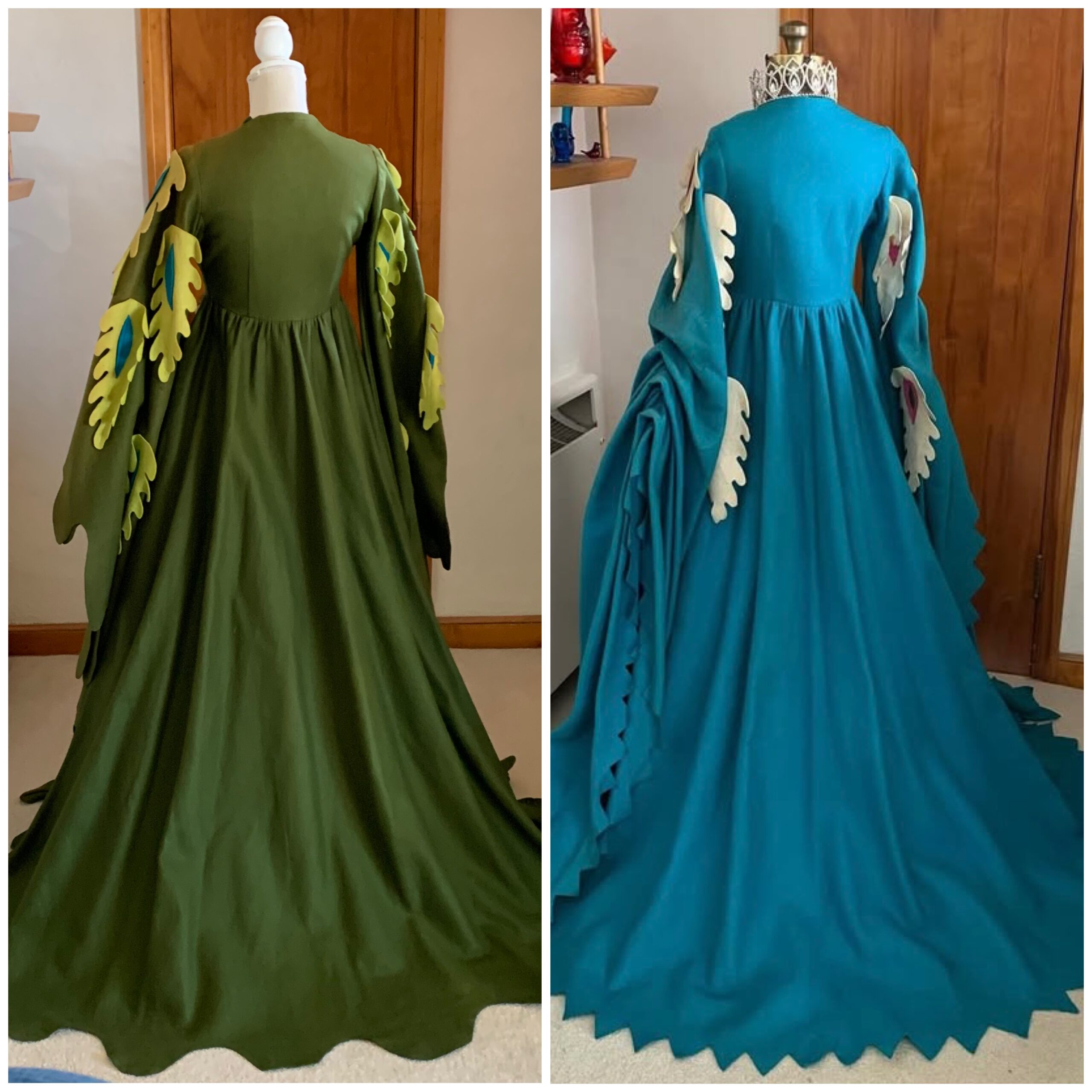
A matched pair of theatrical robes produced by Western Costume Company, executed in dense wool felt and distinguished by large-scale appliqué and exaggerated sleeve construction. One rendered in deep olive green, the other in saturated teal, the garments function as counterparts—variations on a single visual language.
They are not duplicates, but translations.
Material & Structure
Both robes are constructed from a heavy wool felt or felted wool blend, selected for its ability to hold sculptural form without internal support. The fabric resists collapse, allowing the garments to maintain volume across the sleeve and hem.
Unlike historical dress, which relied on layered understructures, these robes achieve presence through material density alone. The weight of the textile produces a delayed, controlled movement—fabric that follows the body rather than moving with it.
Edges are deliberately defined. The hems are cut into rhythmic, organic contours—undulating rather than straight—reinforcing the garments’ departure from naturalism.
Appliqué & Surface Language
Across both garments, appliqué is used not as decoration, but as visual communication.
Large, stylized leaf forms are cut and applied in contrasting tones:
- olive layered with lighter greens and teal accents
- teal paired with pale, almost bone-toned appliqué
These shapes are simplified and enlarged beyond natural proportion. Their purpose is legibility. On stage or on camera, detail must register instantly. These forms function as symbols—nature reduced to gesture.
Placement is intentional. The appliqué travels along the sleeves, extending the arm and amplifying movement. When worn, the body becomes a moving surface, the appliqué activating with each gesture.
Sleeve as Architecture
The sleeves define these garments.
Cut wide and elongated, they move beyond proportion into theatrical scale. They are neither purely historical nor entirely abstract, but exist in a space between reference and invention.
The sleeve becomes:
- extension
- silhouette
- narrative device
As the wearer moves, the sleeve lags, folds, and releases. This delay creates a secondary rhythm—movement that exists independently of the body.
Color as Role
Though structurally aligned, the two robes diverge in tone.
The green reads as grounded, atmospheric—suggestive of landscape, forest, or earth.
The teal shifts toward something less literal—cooler, more distant, almost otherworldly.
In production, such variation often signals differentiation:
- character
- setting
- emotional register
These garments are not simply costumes; they are tools for distinction.
Construction & Use
Interior labels from Western Costume Company are hand-applied, with fields for “Name” and “No.”—a system of cataloging rather than branding.
These garments were not made for individual ownership. They were:
- assigned
- worn
- returned
- reused
Stitching is functional, not concealed. Precision is directed toward visual outcome rather than internal refinement. The garments were built to withstand repetition and adaptation within production environments.
They are working objects—constructed for use within narrative.
Historical Interpretation
While the robes reference historical silhouettes, they do not attempt reproduction. Instead, they distill.
Elements of 19th-century dress—volume, verticality, controlled bodice—are simplified and exaggerated. Detail is reduced to what can be seen at a distance. Texture replaces ornament. Shape replaces intricacy.
This is not history preserved. It is history translated.
Curatorial Note
Viewed together, these robes reveal their intention more clearly than either could alone. They demonstrate how costume operates not as clothing, but as visual language—capable of shaping perception, defining character, and extending the human form into something symbolic.
As part of the archive, they stand as a study in duplication and variation, in how a single idea can be rendered in multiple forms to serve a broader narrative.
They are not garments in isolation. They are counterparts—constructed illusions designed to be seen.
Object Details
Maker: Western Costume Company
Period: Mid-20th century (costume production)
Material: Wool felt / felted wool blend
Construction: Hand-applied appliqué, machine and hand finishing
Use: Film, television, or stage production
Condition: Archive-held; signs consistent with production use