
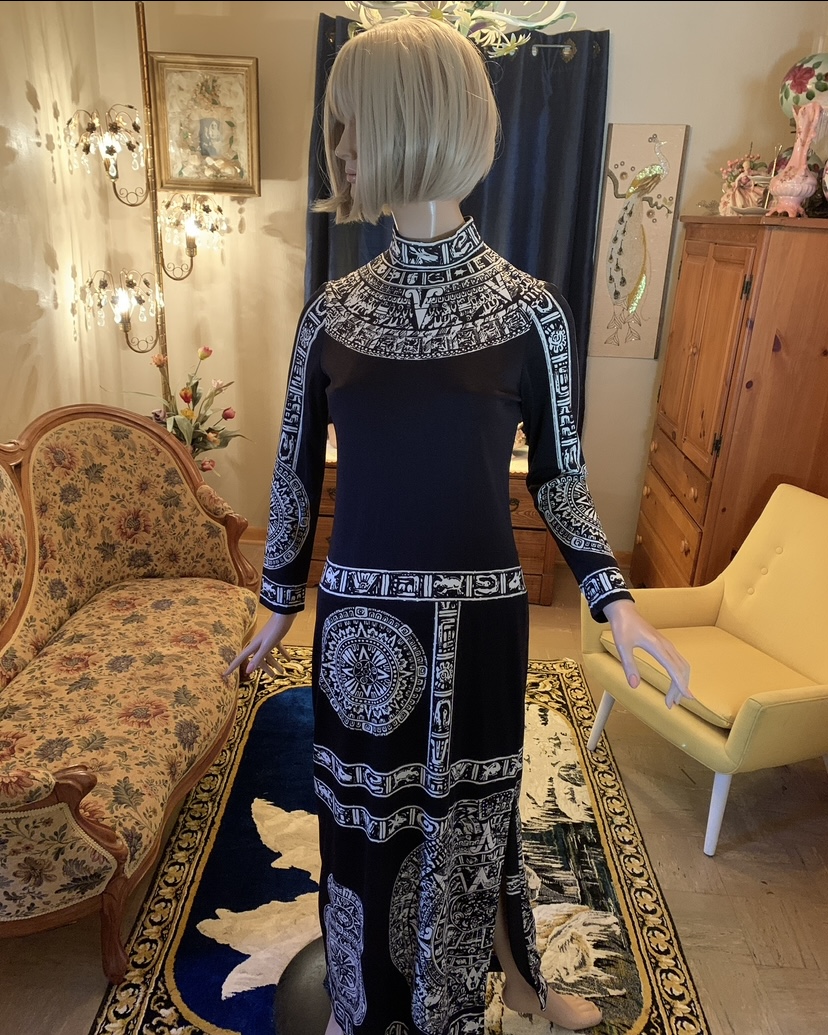
A Dress With a Past: Paganne by Gene Berk, 1971
Every so often, a vintage garment arrives in the archive with more than a label and a beautiful silhouette.
It arrives with evidence.
This early-1970s Paganne by Gene Berk dress is one of those pieces: a dramatic black-and-white jersey design covered in intricate circular medallions, geometric borders and stylized figures. Even without knowing its history, it is unmistakably Paganne—bold, graphic and designed so that the textile becomes inseparable from the shape of the garment.
But this particular print carries an extraordinary piece of documentation.
A surviving photograph from 1971 shows musician Grace Slick wearing the same Paganne design while holding her daughter, China. Rather than appearing in a fashion advertisement or carefully styled editorial, the dress appears in an intimate domestic setting—the kind of photograph that captures fashion as it was actually lived in.
That changes the way we see the garment.
Gene Berk and the Art of the Print
Gene Berk founded Paganne in the mid-1960s after working in fashion merchandising and designing for companies including Oleg Cassini. By the late 1960s and early 1970s, Paganne had developed a visual language all its own.
Berk’s clothing was built around the print.
He reportedly began his textile designs as small drawings in his New York workroom. Those ideas were then sent to artists in Como, Italy, where they were enlarged, refined and translated into screens for fabric production. Finished textiles returned to New York, where Berk determined how the imagery would be positioned across the garment. (Couture Allure)
That process explains what makes the best Paganne pieces so compelling today.
These aren’t simply dresses made from patterned fabric.
The dress is the composition.
On this example, the high collar becomes its own patterned band. Graphic borders frame the shoulders, sleeves and waist. Large circular motifs interrupt the black ground of the skirt, while another sweeping medallion moves dramatically across the lower portion of the dress.
The placement is deliberate. Remove or rearrange any one of those elements and the entire design changes.
A Recognizable 1971 Paganne Design
Another surviving example of this same black-and-white pattern has been documented as an early-1970s Paganne by Gene Berk dress. Its print incorporates elaborate calendar-like wheels and stylized animal and geometric imagery; the vintage source specifically cites a 1971 photograph of Grace Slick wearing a longer version of the design. (Etsy)
An exceptionally similar full-length example has also appeared through Augusta Auctions, described as a 1970s black-and-white Paganne by Gene Berk evening dress with a large abstract wheel motif. (Augusta Auctions)
Together, these surviving garments and photographs give the design something vintage clothing does not always retain:
context.
We can see not only what Gene Berk designed, but how one version of the dress existed in the cultural world of 1971.
Fashion Outside the Fashion Photograph
There is something especially wonderful about the archival photographs connected with this design.
This isn’t a gown frozen beneath museum lighting.
It isn’t being worn by a model against a studio backdrop.
It is a striking piece of early-1970s fashion appearing inside an ordinary room, while a baby is being held, played with and passed around.
The contrast is almost perfect.
The interior still belongs partly to the restrained mid-century world—the upholstered furniture, framed artwork and warm neutral walls—while the dress announces the new decade in black and white: enormous graphics, a high neckline, elongated proportions and a print that refuses to disappear into the background.
That is one of the reasons photographic documentation matters so much in a fashion archive. Clothing makes far more sense when we are able to place it back into the world that originally surrounded it.
Suddenly, vintage becomes less abstract.
Someone actually wore this.
The Paganne Signature
Paganne garments have become increasingly recognizable to vintage collectors because Berk’s work occupies an interesting space between fashion and graphic design.
Period examples survive in museum and university fashion collections, including the Texas Fashion Collection, where Paganne dresses demonstrate the label’s use of signed prints, nylon jersey and carefully placed border motifs. (UNT Digital Library)
The surviving garments reveal why the label remains so distinctive more than fifty years later.
A Paganne dress rarely whispers its decade.
It announces it.
And in black and white, without the psychedelic color usually associated with early-1970s fashion, this design may be even more powerful. There is nowhere for the eye to go except the pattern itself.
Now at Revolving Vintage Closet
More than half a century after that documented 1971 appearance, an example of the design now resides at Revolving Vintage Closet
Placed on the mannequin today, the connection is immediate.
The same extraordinary collar.
The same black field.
The same bands of intricate white imagery moving across the body.
The same enormous circular motifs that made the dress recognizable decades ago.
Finding exceptional vintage is always exciting.
Finding a garment whose design can be traced back through photographs, surviving examples and the history of the designer is something different.
It gives the object a second life—not by recreating its past, but by preserving enough of that past that it can still tell us something.
Some dresses survive because they were saved.
The remarkable ones survive with their stories still attached.
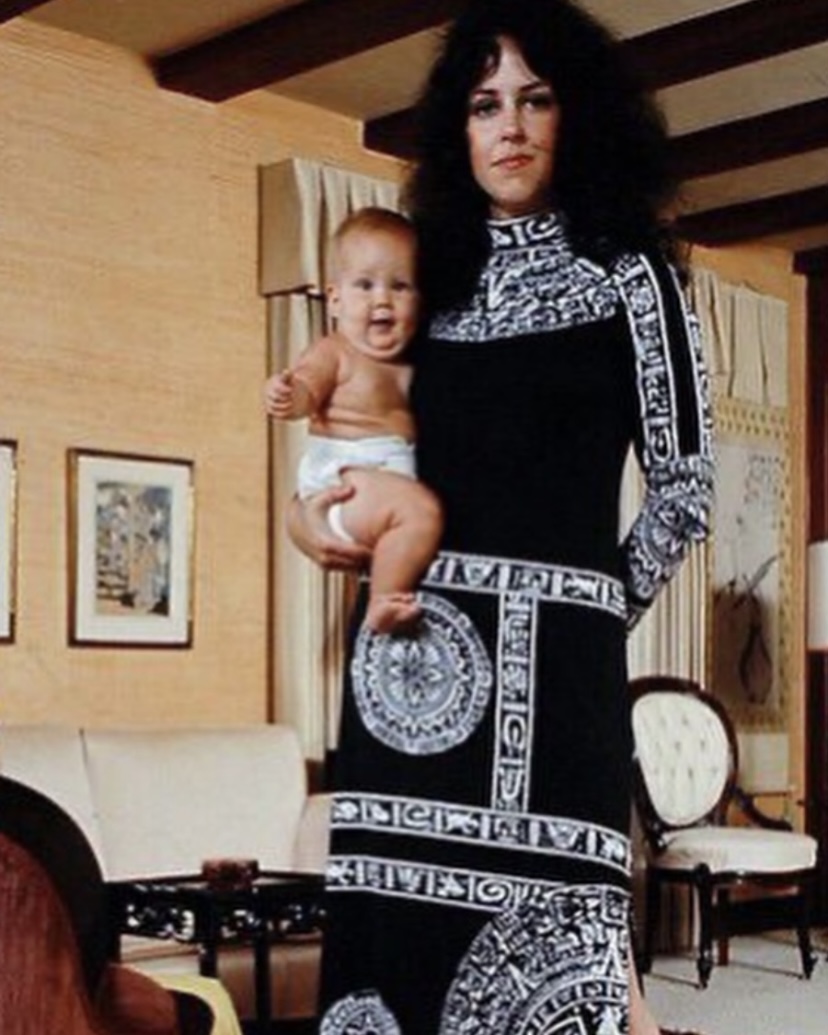
Grace Slick wearing the same Paganne by Gene Berk design, 1971.